Friday, September 27, 2019

How to Get Federal Contracts: Tips for Women Business Owners

The federal government sets aside some of its federal contracts for women business owners. Is your business ready to compete for them?

For six years in a row, the federal government has achieved a goal set way back in the 1990s of awarding a minimum of 25% of all federal contracts to small businesses. That’s great news—but the federal government is still falling short of another long-time and equally important goal: awarding women-owned small businesses at least 5% of all federal contracts.

Women-owned small businesses received 4.75% of all federal contracts in fiscal 2018. So close to the goal! There is no good reason women business owners shouldn’t be playing a bigger role in federal government contracting. As of 2017, over 11.6 million women-owned firms across the U.S. employed nearly 9 million people and generated $1.7 trillion in revenues, NAWBO reports.

But in order to hit the 5% procurement goal, more women entrepreneurs will have to start competing for federal contracts. Could your small business be one of them? Keep reading to learn more about how women-owned businesses can get federal contracts.

How federal contracting opportunities for women work

Of course, women business owners can compete for any kind of federal government contract if they want to. But some contract opportunities are specifically limited to women-owned businesses. The goal is to help level the playing field for female entrepreneurs in industries that historically lack women-owned businesses.

The federal government sets aside a certain percentage of federal contracts for Women Owned Small Businesses (WOSBs). There are also some contracts that are set aside for Economically Disadvantaged Women Owned Small Businesses (EDWOSBs).

In order to compete for these EDWOSB or WOSB set-asides, your company must get certified as a woman-owned business. This requires your company to be at least 51% owned and controlled by women, who must make the primary decisions for the business. You’ll also need to meet SBA size standards and other criteria to be certified.

There are two options for certification. You can self-certify your business at certify.SBA.gov or go through a third-party organization that is authorized to certify WOSBs and EDWOSBs. There are four of these organizations across the country, each of which handles a different geographic area. Learn more about the WOSB program.

Before getting certified, your need to register your business with the System for Award Management (SAM). This online registry is free; federal agencies use it to find potential contractors.

Other Articles From AllBusiness.com:

Where to get help competing for federal contracts

After going through a lot of effort, my company was certified as a Women’s Business Enterprise (WBE) several years ago. We’re proud of our certification and excited that we can compete for government contracts. But the certification process wasn’t easy, and we couldn’t have done it without expert guidance from outside resources.

Trying to decide if federal contracting is right for you, and wanting to know how to find contracting opportunities and what’s involved in the bidding process? Here are some resources to get you started:

(Disclosure: SCORE is a client of my company.)

RELATED: 5 Essential Steps for Women Who Want to Become Entrepreneurs

The post How to Get Federal Contracts: Tips for Women Business Owners appeared first on AllBusiness.com

The post How to Get Federal Contracts: Tips for Women Business Owners appeared first on AllBusiness.com. Click for more information about Rieva Lesonsky.


from neb biz feed 1 https://ift.tt/2mjjNj2
via Nebula Biz Local Loans

7 Ways to Increase the Credibility of Your Blog Content

Would you believe I’ve written thousands of articles over the past decade? Each time I write a new article, I have to find a way to make the subject fresh again. I want to ensure that my readers find what I write useful and informative, so I use the following strategies to build credibility with my content. Feel free to use these tips for your own content and see if you attract more blog visitors!

1. Find statistics to back your content

I wanted to find a statistic about using statistics in your content marketing, but couldn’t find one! Until proven otherwise, your content is conjecture. It’s your opinion. That’s why adding statistics and research to your blog articles can help you validate your point of view.

Let’s say I’m writing an article arguing that content marketing can be more effective than any other type of marketing or advertising. That’s just my opinion at this point, but my reader wants proof:

Think content marketing is too big a headache to bother with? Think again, at least if you want to attract new business: content marketing gets 3x the leads per dollar spent than paid search does. Why are you still wasting money on the wrong marketing tactics?

Instantly, I’ve got backup for my argument that content marketing rocks.

Always link to the original source of the statistic. If you found it on a roundup of other statistics, click to the original data. I try to keep the stats I use within a year old so they’re not too crusty to be useful.

2. Source experts to share their perspective

Another way to make your blog content more credible is to ask industry experts to weigh in on a topic. There are actually two benefits to this approach: you get their wisdom and then you most likely get their support in sharing your article once it’s published, so your content reaches more people!

I like to have a few questions that I send select people. If I’m writing an article about content marketing, I might ask:

  • Why is content marketing more effective than, say, digital advertising?
  • What types of content have you seen phenomenal results with?
  • How can businesses drive leads from a blog article?

I’d send a friendly email to people I already know or who I’m connected with through social media and ask them to answer the questions. I’d give a deadline so they feel a sense of urgency. The result is a nice, long post with different points of view on my topic.

3. Read what’s out there before you write

Even if you know your subject matter inside and out, you should still know what else has been written on this subject before you dive in. I simply Google my topic and read the top results. I’ll usually get ideas for my content and may wander further down the rabbit hole, searching for more specifics I want to include in my article.

Your goal here isn’t to rehash what’s already been written. It’s to find gaps in the existing content on this topic and find a way to write from a different perspective or present a new angle to the story. You can only do that if you know what’s been published.

4. Bold the good stuff

If you’re like 43% of people, you skim blog posts. (There’s your statistic!) People don’t always have time to sit down and read a 3,000-word post—a trend I’m not a fan of. Say it succinctly. They’ll scroll down the page and try to glean what’s most important in the post.

Rather than fight the nature of human beings, make it easier for them. Bold sentences that contain key facts so they can find them easily.

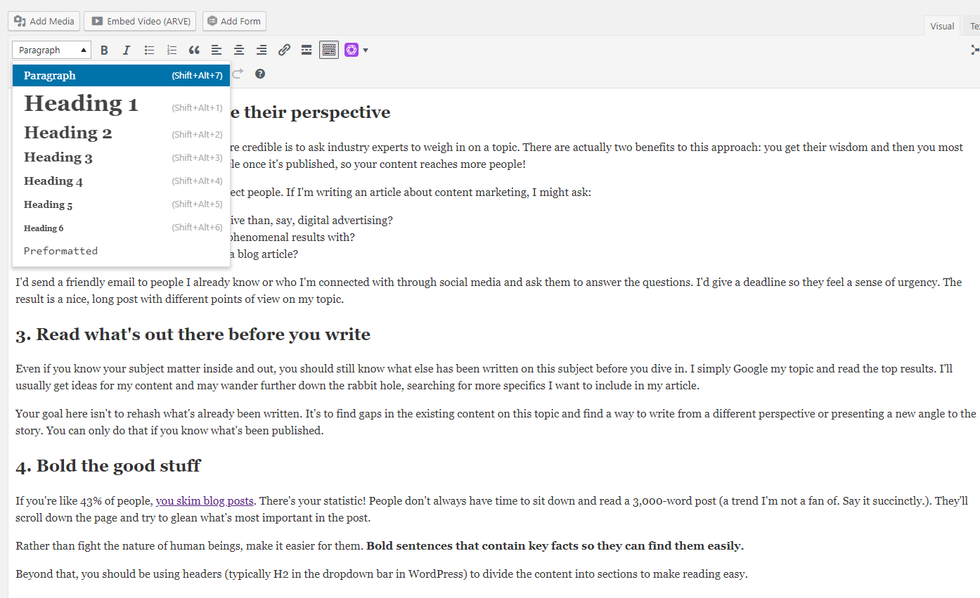
Beyond that, you should be using headers (typically H2 in the dropdown bar in WordPress) to divide the content into sections to make reading easy.

5. Use images to illustrate a point

If your article is technical or explaining a process, take screenshots to show your readers exactly how to do something. I did just that in the last section to show you where to find the H2 option.

If you’ve got a ton of research in your posts, consider creating custom charts, graphs, or infographics to make the data more digestible.

If your content doesn’t lend itself to screenshots or charts, use stock photos to keep readers interested visually.

Other Articles From AllBusiness.com:

6. Talk to your audience directly

There’s a careful balance of not talking over your readers’ heads while also not treating them like children. You first have to start by knowing who your audience is. If it’s rocket scientists, you better be as smart as a rocket scientist so you can speak intelligently to that audience. If it’s a mixed bag, write to about a seventh-grade audience.

Where did that number come from? There’s something called the Flesch-Kincaid readability score, which analyzes your content to determine what grade level could understand it and how readable it is. If you’re not sure if your content is hitting the mark with your audience, use this readability test to see how it fares.

7. Back up your content with examples

If you’re talking about something you think your audience should do (use content marketing, for instance), have examples that prove your point. It could be from your experience working with clients or case studies you pull from online.

For my article on content marketing, I could talk about the work I’ve done for a mobile marketing company, helping them effectively establish themselves as a leader in their space. That might compel readers to want to work with me.

I hope these tips help you enhance your content and build credibility with your blog. Remember: it’s brands that put effort into the content they create that attract more blog visitors and customers.

RELATED: 20 Financial Bloggers Share Their Secrets to Running a Successful Blog

The post 7 Ways to Increase the Credibility of Your Blog Content appeared first on AllBusiness.com

The post 7 Ways to Increase the Credibility of Your Blog Content appeared first on AllBusiness.com. Click for more information about Susan Guillory.


from neb biz feed 1 https://ift.tt/2mVWH1Y
via Nebula Biz Local Loans

8 Tips on How to Prepare Your Business for Sale

By Laura Babcock

Selling a business is complicated. You’ve put years of hard work into building up a company that is a significant part of your life. Maybe you also sunk a lot of cash into the business to help get it started and then again through all the rocky moments along the way.

Between your sweat equity and capital investment, you have an expectation of what your business is worth. So you want to sell. Cash out. Retire to Arizona or Florida. Never mind what your business tax returns show. You know what your business is worth. You deserve it! You’ve earned it!

Selling a business is also tricky because it can get emotional. This is your baby. Something you may have started from scratch and built into a thriving business. You’re proud of your accomplishments, and you should be. You expect compensation for what you’ve created.

But what happens when no one wants to buy your baby? You think, “No one sees my vision, understands my passion,” or you think they want an easy way into business ownership.

Have reasonable expectations

According to BizBuySell.com, only one in five of their business listings get sold. That either means there aren’t many people looking to buy a business, or there are a lot of sellers with unreasonable expectations (in other words, overpriced businesses for sale). I’ll put my money on the latter option.

Take Gerald for instance (all names have been changed). Gerald owned a paint store in a smallish town in southern Minnesota. He and his wife Evie owned and managed the store for thirty-plus years. Gerald had one key employee and would sometimes hire part-timers to fill in during busier times. The paint store had several customers who were regular clients, mostly painting contractors, who had done business with Gerald for years. Business was good. Life was good. Gerald and his wife owned the building that housed the paint store, they had put two sons through college, they vacationed in Florida, and they paid very little income tax.

But then Gerald and Evie had some serious health scares and decided it was time to sell the business. Neither of their sons wanted to take over so they contacted a business broker. They were excited. Gerald and Evie started looking into the cost of homes in Florida. They were sure the business was worth more than what a vacation home cost. Woo-hoo!

Then the broker asked to see inventory records and agreements with the paint supplier. He asked to see the deed on the building, financial statements for the last three years, and . . . ba-boom: tax returns.

Gerald asked if this was all necessary. Couldn’t they base a sales price off their annual revenue? Sales were good. Anyone could come in here, own the business, and make a decent living. Why did it have to be so complicated?

Now, in Gerald’s defense, he knew he wasn’t the best recordkeeper, so he used an outside bookkeeper. Problem was, Gerald never took the time to understand what she was keeping track of. The records were confusing, and as the broker found out, incomplete. As for taxes, Gerald’s tax preparer had for years suggested ways to minimize their tax liability by taking certain deductions. It was all legal, but it didn’t make the business look profitable.

The broker explained that no one wants to buy a business that can’t prove their profitability or at least the potential for profitability. And a bank won’t approve a loan on a business that can’t provide facts about the health of the business.

It’s all about minimizing risk. You have to look at the facts and be realistic in your expectations of what you will get out of the sale.

Other Articles From AllBusiness.com:

Early planning pays off

Depending on your situation, you may want to start planning several years in advance, particularly if your financial statements are shaky. And don’t expect the offers to come pouring in once you list. While the median length of time a business is on the market is six months, be prepared to have your business listed for 12 months. And once an offer is accepted, plan on two to three months to close.

So if you’re thinking of selling, here are some tips to maximize your chances of a speedy sale:

1. Price it right. Use a professional business appraiser or broker if you’re having trouble pricing your business. Make sure your expectations are realistic and based on information you can prove.

2. Time it right. Sell your business when it looks the best. If you just snagged a big contract or received some great press coverage, that’s a good time to list.

3. Get your financials in order. You will need to provide three years of financial statements including tax returns. Also, make sure there is adequate cash flow that will continue after the business is sold. It’s also a good idea to ensure any current financing the business carries has reasonable terms.

4. Diversify. Make sure your customer base is diversified instead of just a few main clients. Likewise, make sure your revenue isn’t coming from just one or two salespeople. Both scenarios could signal additional risk to a buyer.

5. Plan for how the business will be managed after the sale. Are you a critical figure in managing your business? Unless you’re a one-person operation and the buyer has that same expertise, make sure there are key people in place who know how to carry on without you.

6. Keep your employees in mind. If you have employees, make sure all policies and procedures are in writing. You want to make sure that not only the business continues smoothly, but that the employee’s expectations are kept. If the new owner wants to change things, fine. But at least the new owner will know what the employee expectations are if everything is in writing.

7. Document. Make sure all customer and vendor agreements, partnerships, contracts, and any other important negotiations or arrangements are in writing.

8. Look good. Just like selling a home, make sure your business has good curb appeal. Declutter, repair, clean, repaint, freshen up, etc. First impressions are huge. If your normal work mode is a desk stacked high with piles of paper, or worse, you operate within a personal tornado of chaos—clean up your act. Otherwise, a buyer will think that other areas of your business are just as chaotic and they may run the other way.

So you’re probably wondering, whatever happened to Gerald? Well, there weren’t multiple buyers beating down his door. Actually, there was only one. It came from Gerald’s long-time employee, Steve, at the paint store.

Gerald was thrilled and even offered to finance the transaction. He and Evie could wait on purchasing their Florida vacation home, and besides, there were tax advantages with spreading the payment out over several years. Then Steve looked at the financials. Steve felt Gerald’s asking price was too steep, and things fell apart from there.

Gerald still owns the paint store and Steve still works there. Their relationship is strained, and now Gerald’s health is deteriorating. No one is sure what will happen to the store. It’s an unfortunate situation that could have been prevented with adequate foresight and planning.

If you’re looking to someday sell your business (every business owner should have a succession plan, but that’s an article for another day), start planning now. It’s not too early. With strategic preparation, when you’re ready to sell you just might get the price you’re asking for.

RELATED: Selling a Business? Consider These Valuable Lessons From Baseball Great Yogi Berra

About the Author

Post by: Laura Babcock

Laura Babcock has been involved in entrepreneurship most of her life, starting at age 6 when she began selling Kleenex tissues to neighbors—a penny apiece. Over the years other endeavors followed but nothing extremely successful, if you’re judging success through a fiscal lens. If passion ensured financial triumph, Laura would be on a beach in Bali sipping piƱa coladas. But, alas, Laura learned that understanding marketing and financial management are key to a small business’s success. So, when her last business closed after a seven-year run, she decided to go back to school and complete a bachelor’s degree in Marketing Communications. For the last seven years, Laura has also worked for a nonprofit organization dedicated to helping entrepreneurs. Currently, Laura is a marketing consultant and fledgling copywriter.

Company: GetBetterContent
Website: www.getbettercontent.com
Connect with me on LinkedIn.

The post 8 Tips on How to Prepare Your Business for Sale appeared first on AllBusiness.com

The post 8 Tips on How to Prepare Your Business for Sale appeared first on AllBusiness.com. Click for more information about Guest Post.


from neb biz feed 1 https://ift.tt/2mQpeG3
via Nebula Biz Local Loans

3 Simple Ways Your Website Can Help You Earn Consumer Trust

Trust is something that’s required in order for a brand to generate a loyal following. It’s also something that has to be genuinely cultivated. In other words, trust can’t be purchased or faked. And in a world where online interactions often characterize brand-consumer relationships, a company’s website is one of its greatest resources.

Establishing trust online

Trust has and always will be an integral part of any relationship. Whether it’s a romantic partnership, a platonic friendship, or an interaction between a brand and a customer, some element of trust must exist in order for that relationship to continue. But it’s safe to say that, within the context of business, brand trust has become more important than ever before.

Today’s customers have more options to choose from than they did even 10 or 15 years ago. Whether a customer is buying a pair of socks or a new car, there are dozens of brands to choose from. Customers will naturally flock to the ones that have their trust and respect.

“It’s a global, 24/7 world that maximizes the offer of competition. But it can also be a confusing state of product and/or service credibility. Without trust, marketers are in fractured pursuit of customer engagement and customer loyalty,” branding strategist Jaid Hulsbosch explains.

Other Articles From AllBusiness.com:

There are plenty of platforms built for fostering trust. You can use social media, third-party marketplaces (like Amazon), PPC advertising, review sites, Google, etc. But as useful as these platforms are, they all have one glaring weakness: someone else controls them. If Facebook suddenly goes under, you no longer have your followers. If Google enacts a change to its algorithm, you could quickly plummet in the search rankings. If a review website decides they don’t want to include your company anymore, it’s perfectly acceptable for them to delist you. What you need is a trust-building mechanism that you control.

In the online world, there’s only one asset or platform that you have 100% control over: your website. Nobody can tell you what to post, how to structure your content, or what rules to follow. You call the shots. This makes it the perfect platform for establishing and cultivating trust.

Every page on your website matters, but the homepage is the stickiest and most visible. It’s recommended that you use it as your primary trust-building URL. Here are some ways to do just that:

1. Use a clean layout

Stop with the superfluous design elements that clutter up and bog down your homepage. If you’re trying to do everything on your homepage all at once, you’re doing too much. It’ll only confuse and overwhelm people.

Cut the fat and use a clean layout. The UAKC homepage is a great example. Notice how they establish trust through high-quality imagery and minimal layout/design. They also include their core values of honesty, integrity, accountability, directness, and transparency at the bottom of the page. When combined with the streamlined design, this sort of high-impact copy makes a massive statement.

2. Use authentic images

“Horribly generic and formulaic stock photos are everywhere. While there’s nothing wrong with using carefully curated stock imagery in the right places, it’s much better to favor website visuals that look like they were actually taken of you and your team in real situations,” marketing expert Ben Jacobson writes for HubSpot.

Hire a professional photographer for a couple of hours and have your team photographed. Take some headshots, but also ask for candid shots of your people in action. These images are worth their weight in gold. When properly integrated into your homepage, they provide visitors with a behind the scenes look at what your team is really like.

Marketer Melyssa Griffin’s website offers a perfect example. She uses authentic images that show people her personality and character.

3. Serve the visitor

A good homepage is never selfish. Instead of serving your own needs, it exists to selflessly add value to the visitor. (Ironically, this indirectly benefits your business, too.)

Rather than post a bunch of selfish calls-to-action and intrusive pop-up boxes and opt-in forms, consider adopting a counterintuitive approach. Provide value by offering free content with no strings attached. Show that you care by giving away information that your audience needs. When visitors see that you genuinely care, they’ll be more likely to trust you. You won’t have any trouble monetizing this trust in the future.

Final thoughts

Trust is fluid. It’s not something you earn once and then continually benefit from for years to come. You have to rebuild trust every single time you interact with a customer. Your website’s homepage is just the start. Whether it’s a podcast, billboard advertisement, or chance encounter with a client when you’re having lunch with your family, make sure you’re continuously prioritizing trust. It’s the only way to get ahead in today’s crowded marketplace.

RELATED: 5 Personal Branding Hacks Every Entrepreneur Should Know

The post 3 Simple Ways Your Website Can Help You Earn Consumer Trust appeared first on AllBusiness.com

The post 3 Simple Ways Your Website Can Help You Earn Consumer Trust appeared first on AllBusiness.com. Click for more information about Larry Alton.


from neb biz feed 1 https://ift.tt/2lDKMWu
via Nebula Biz Local Loans

Thursday, September 26, 2019

10 Questions From Young Entrepreneurs About Startups

Who says you can’t start a business when you’re young? These days, more and more young entrepreneurs who are full of great ideas, passion, and drive are launching their own companies—any many are finding success.

I recently had the pleasure of serving as a mentor to a number of young entrepreneurs as part of the innovative U.C. Berkeley-Hass Entrepreneurship Program, which is under the outstanding leadership of Rhonda Shrader and Adeeba Fazil. The program offers undergraduates, graduates, and alumni an opportunity for career counseling, professional networking, and more to help boost their entrepreneurial endeavors.

The young entrepreneurs I counseled had some great, creative ideas for different startups, and many of them had already gotten some early traction in their businesses. They also had some great questions—questions that many entrepreneurs, young or old, have about starting, growing and financing a business. So I thought I would share my answers to those questions here.

1. I’m Just Starting My Business. What Kind of Entity Should I Set Up?

The founders of a company must initially determine whether to organize the company as a limited liability company (LLC), general partnership, a sole proprietorship, or a corporation. If formed as a corporation, the company must also determine whether to file an election to have it taxed as an “S corporation” rather than a “C corporation.”

S corporations are corporations that elect to pass corporate income, losses, deductions, and credits through to their stockholders for tax purposes. Stockholders of S corporations report the flow-through of income and losses on their personal tax returns and are assessed tax at their individual income tax rates (so called “flow-through taxation”). This allows S corporations to generally avoid double taxation on the corporate income.

A C corporation under federal income tax laws is one that is taxed separately from its owners. Generally, all for-profit corporations are classified as C corporations, unless the company validly elects to become an S corporation. A C corporation does not have limits as to who could be the stockholders (as S corporations do). And C corporations may have different classes of stock (such as preferred stock and common stock), which is not allowed for S corporations. Venture capitalists will typically only invest in preferred stock in a C corporation.

An LLC is another entity that provides limited liability to its owners the way C and S corporations do, and an LLC also provides flow-through taxation to its owners.

So what type of entity should a founder form?

  • Never form the company as a general partnership or sole proprietorship, as these have the huge disadvantage of potential liability to the owners for the debts and liabilities of the business.
  • If properly structured and run, LLCs and corporations can protect the owners from personal liability if something goes wrong with the business.
  • If the company will be getting outside investors, it will most likely need to be a C corporation.
  • If it’s a simple company with one or two individual owners, an S corporation makes sense. You can always convert it later to a C corporation.
  • If the owners want greater flexibility for types of owners and wish to avoid the restrictions of S corporations, then an LLC or C corporation can make sense, although LLCs tend to be a bit more complicated to set up and maintain (and more complicated for tax filing purposes).

For a comprehensive discussion of tax issues in startups, see Pay Attention to These 9 Essential Startup Tax Issues.

2. Where Should I Incorporate My Startup?

Corporations are formed pursuant to a state’s laws. Many people recommend incorporating under Delaware law, but my preference is to incorporate in the state where the business is located, as this will save you some fees, filings, and complexities. You can always reincorporate later in Delaware if desirable.

3. I Have a Great Idea That Has No Competition. How Can I Protect It So Others Don’t Steal My Idea?

Ideas are a dime a dozen; it’s the actual implementation of an idea that is more important. If it’s truly unique, get a patent for it (visit www.uspto.gov). You may get some protection through copyright, trade secret programs, or NDAs—but not a lot (see The Key Elements of Non-Disclosure Agreements). You can’t worry too much about someone stealing your idea. The best thing to do is implement the idea and get a lot of traction for it.

If you think there is no competition for your idea, you are likely dead wrong. I’ve had multiple entrepreneurs over the years tell me they had no competitors, something I was able to quickly disprove with a simple Google search.

4. How Should Equity Be Divided Among My Co-Founders?

There is no one correct answer to this question. But you should discuss it with your co-founders and agree upon it up front to avoid any misunderstandings later on. If you are the original founder and the brains behind the idea, a good argument can be made for more than 50% ownership. The split should take into account the following:

  • The relative value of the contributions of the founders
  • Who came up with the idea for the business
  • Vesting dependent upon continued participation in the business (you don’t want to give away 25% of the company to someone who leaves after a few months)
  • The amount of time to be committed to the business
  • The cash compensation to be paid as an employee (or reduced salary that a founder is willing to take in exchange for equity)
  • Whether someone will be contributing cash as investment in the business
  • Whether one person wants to maintain control over decision making
  • The fact that additional dilution will occur in the future as you bring in investors or grant options to new employees

5. Do I Need a Technical Co-Founder for My Business?

If you are not a technology expert, and technology is going to be crucial to your startup, then it will be helpful to have a technical co-founder (or, at the very least, a senior-level hire who can handle the key technology functions). Investors and incubator programs like Y Combinator often like to see technology-oriented co-founders. But that doesn’t mean you have to give this co-founder 50% of the equity.

6. How Can I Come Up with a Great Name for My Startup?

This can be difficult. First, brainstorm a bunch of different names, then do a Google search to see what is already taken—I’m betting this will eliminate 95% of your choices. Make it easy to spell. Make it interesting. Don’t pick a nonsensical name so people won’t have a clue as to what your business actually does (with all due respect to “Google” and “Yahoo”). Do a trademark/tradename search on the name, then make sure you can get the domain name (see 12 Tips for Naming Your Startup Business).

Every good “.com” domain name is already taken; however; I usually only recommend obtaining “.com” names. Ultimately, 99% of domain names are available to be bought—you just have to be prepared to pay for it. Do a “WHOIS Search” at networksolutions.com to find out the contact information for the owner of the domain name you’re interested in, and offer to buy the name. Don’t be naive and offer $500 for a premium domain name. You will be ignored. Be willing to pay a fair amount for a good name (see Key Steps in Obtaining a Great Domain Name).

7. I Have an E-Commerce Business. How Can I Drive Traffic to My Website?

To be honest, entire books are written on this topic. But, in brief, the key ways are as follows:

  • Pay Google, Bing, Yahoo, Facebook, or other sites to send you traffic (such as through the Google Ads program). However, this is often expensive and not cost-effective, so you need to do testing/pilot programs to see what keywords work and at what price.
  • Build a great site with lots of high-quality, original content that is search engine optimized as well as optimized for mobile traffic. Continue to add fresh content to the site.
  • Have a smart social media plan to drive traffic from Facebook, YouTube, Twitter, LinkedIn, Instagram, Pinterest, and other free social media sites.
  • Prepare well-written articles and try to have them posted to other quality sites such as AllBusiness.com or com, with links back to your site.

8. What Are the Biggest Mistakes Made by Startup Entrepreneurs?

New entrepreneurs can make many mistakes, but here are some of the most common:

  • Not starting with enough capital
  • Thinking that success will come quickly
  • Not carefully budgeting and forecasting when money will run out
  • Not focusing on the quality of the product or service
  • Not understanding the “product/market fit”
  • Underestimating the importance of sales and marketing
  • Taking too long to build out a product—the pursuit of perfection can delay meaningful progress
  • Not adapting or pivoting quickly enough
  • Not understanding the competition
  • Ignoring legal and contractual matters (especially intellectual property and employee issues)
  • Hiring the wrong employees (and not firing them quickly enough)
  • Mispricing the product or service
  • Underestimating how hard it is and how long it takes to raise financing from angel or venture capital investors

9. How Can I Raise Angel or Seed Financing for My Startup?

If you only have an idea and little or no progress in executing that idea, you likely won’t be able to obtain angel or seed financing from professional investors. So, in that situation, you will have to rely on family and friends, or perhaps consider crowdfunding sites such as Kickstarter or Indiegogo.

Most professional seed or angel investors want to see some traction in the business, such as:

  • Working prototype of the product
  • Initial revenues
  • A great management team (very few investors want to invest in a one-person company)
  • Strategic partnerships
  • Initial or pilot customers, especially brand-name customers
  • Customer testimonials
  • Admission into competitive programs such as Y Combinator or other technology accelerators or incubators

The more traction you have obtained, the more likely you will be able to raise financing and get a desirable valuation.

How can you get investors interested in you? Investors get inundated with unsolicited executive summaries and pitch decks from startups. Most of the time, they ignore these solicitations. The way to capture their attention is to get a warm introduction from someone they know and trust: another entrepreneur, a lawyer, an investment banker, an angel investor, or another venture capitalist. Check to see if you have any LinkedIn connections to the investor.

See 15 Tips for Startups Seeking Angel or Seed Financing.

10. Do I Need an Investor Pitch Deck to Get the Interest of Angel or Venture Capital Investors?

Yes, you do. Raising capital from investors is difficult and time consuming. Professional investors expect to see a concise and interesting summary of the business before they will even consider taking a meeting. Therefore, it’s crucial that a startup creates a great investor pitch deck that tells a compelling story.

You want your investor pitch deck to cover the following topics, roughly in the order set forth here and with titles along the lines of the following:

  • Company Overview (give a summary overview of the company)
  • Mission/Vision of the Company (what is the mission and vision?)
  • The Team (who are key team players? what is their relevant background?)
  • The Problem (what big problem are you trying to solve?)
  • The Solution (what is your proposed solution? why is it better than other solutions or products?)
  • The Market Opportunity (how big is the addressable market?)
  • The Product (give specifics on the product or service)
  • The Customers (who are the target customers? why will there be a big demand from these customers?)
  • The Technology (what is the underlying technology? how is it differentiated?)
  • The Competition (who are the key competitors? how will you be better than the competition?)
  • Traction (early customers, early adopters, revenues, press, partnerships)
  • Business Model (what is the business model?)
  • The Marketing Plan (how do you plan to market? what do you anticipate for customer acquisition costs vs. the lifetime value of the customer?)
  • Financials (projected revenues, key assumptions, and EBITDA)
  • The Ask (how much capital are you are trying to raise? what progress will you make with that capital?)

Here are some helpful pitch deck tips:

  • Tell your story in 15 to 20 slides. (If you can’t tell the story with brevity, you can’t tell it well.)
  • Explain why the market opportunity is large.
  • Describe the talent on your team.
  • Don’t provide excessive financial details. Hit the key indicators and save the rest for follow-up.
  • Don’t try to cover everything in the pitch deck. Your in-person presentation will give you an opportunity to add and highlight key information.
  • Use plain English—too much jargon or acronyms can distract from your story.
  • Don’t underestimate or belittle the competition.
  • Make sure your information and metrics are up-to-date.
  • “Look and feel” matters. Think of it as your investor interface, and consider getting professional help from a graphic designer.
  • Review other pitch decks for ideas on presentation. Do a Google search and you will find hundreds of pitch decks online.
  • Be sure to include the following wording at the bottom left of the pitch deck cover page: “Confidential and Proprietary. Copyright (c) by [Name of Company]. All Rights Reserved.”
  • Send the pitch deck in a PDF format to prospective investors in advance of a meeting. Relying on Google Drive, Dropbox, or some other online service just puts up a barrier to the investor actually reading it.

For additional guidance, as well as sample pitch decks, see How to Create a Great Investor Pitch Deck for Startups Seeking Financing and The 17 Biggest Mistakes Startups Make With Their Investor Pitch Decks.

Related Articles:


Copyright © by Richard D. Harroch. All Rights Reserved.

The post 10 Questions From Young Entrepreneurs About Startups appeared first on AllBusiness.com

The post 10 Questions From Young Entrepreneurs About Startups appeared first on AllBusiness.com. Click for more information about Richard Harroch.


from neb biz feed 1 https://ift.tt/2nGlebQ
via Nebula Biz Local Loans

How to Get the Most Out of the Walmart Rewards Mastercard

For true-blue Walmart fans, the Capital One Walmart Rewards Mastercard is a value magnet, whether you shop with the retailer in-store or online. After all, you’re earning rich rewards on many already discounted items. Those rewards include: 5% back on Walmart.com and Walmart app purchases. 2% back on in-store purchases at Walmart (including at Murphy USA...


from neb biz feed 1 https://ift.tt/2mZnRFo
via Nebula Biz Local Loans

Cathay Pacific Flights Are Now Bookable on American’s Website

It’s now possible to book Cathay Pacific award flights directly on American Airlines’ website. Previously, if you wanted to book a flight on Cathay Pacific using American Airlines AAdvantage miles, you had to call American Airlines customer service. What this means for flyers The addition of Cathay Pacific flight awards to American’s search engine is...


from neb biz feed 1 https://ift.tt/2lwWEtg
via Nebula Biz Local Loans